
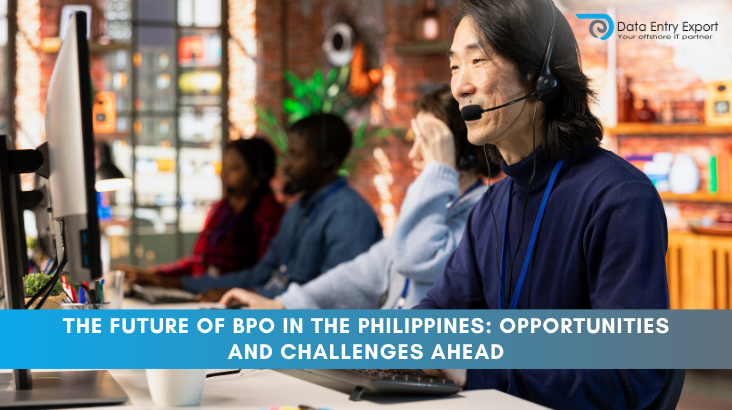
The Philippines has long been a key outsourcing destination for global businesses. No wonder the nation has achieved this position, thanks to its versatile workforce and strong compatibility with Western markets. As of 2025 and beyond, the Philippines’ BPO firms continue to evolve and expand their offerings, adapting to technological advancements, shifting customer demands, and emerging global trends. This blog explores the opportunities and challenges of outsourcing to the Philippines.
Major Services Outsourcing to the Philippines
- Customer Support
- IT and Software Development
- Healthcare Services
- Financial and Accounting Services
- Human Resource and Payroll Management
Opportunities on the Filipino BPO Horizon
- Expansion of Knowledge Process Outsourcing (KPO) – Although the likelihood of BPO operations stays strong, the industry is expanding its capabilities by rolling out knowledge process outsourcing (KPO) services. The following are some of the higher value services that are becoming trending today;
*Data Analytics and AI-powered Solutions
*Cybersecurity Services
*Digital Marketing and Content Moderation
*Cloud Computing and SaaS Support
As the Philippines’ outsourcing firms prioritize upskilling employees and technological advancements, companies can acquire quality-rich, higher-value services. In fact, the transition towards specialized services is driven by global demand and the need to thrive in a competitive business world.
- Rise of Remote and Hybrid Working Models – The COVID-19 pandemic paved the way for the accelerated adoption of work-from-home and hybrid working models. In fact, this shift was a chance for the Filipino BPO employees to prove they can deliver exceptional services remotely. Furthermore, the flexible working schedules reduced operational expenses for BPO companies, expanded the skills of the Filipino workforce, and, most importantly, improved employee satisfaction and retention metrics. The widespread acceptance of remote work has encouraged the expansion of outsourcing firms into rural areas. Consequently, it enabled companies to access more affordable services from the best outsourcing firms across the Philippines.
- Growing Demand for Cloud Services – Remote work has opened the door to a shift from traditional storage systems to cloud-based solutions. Through cloud platforms, the Philippines’ outsourcing firms are better equipped to deliver reliable services, with greater agility, cost efficiency, and advanced security. Consequently, companies worldwide can acquire multifaceted benefits from cutting-edge solutions backed by cloud technologies.
- More Adoption of AI and Automation – Rather than replacing jobs and employees, the adoption of AI and automation increases the efficiency of BPO operations. Moreover, the adoption of chatbots, predictive analytics, interactive voice response systems, and robotic process automation is enhancing customer experience. Therefore, by collaborating with Filipino BPO firms, companies can acquire top-notch services to tackle the competitive digital world, meeting the evolving customer expectations.
- Government Support and Infrastructure Development – The Philippine government has implemented policies to foster the growth of the BPO industry. Some of them include allowing IT-BPM companies to integrate remote working models without losing tax incentives. In addition, the Filipino government has invested in infrastructure and education, aiming to uplift the country’s BPO sector to a more competitive global position.
- Outcome-based Contracts – The Filipino outsourcing firms now offer outcome-based service contracts for customers. That is, customers can now acquire services to achieve specific goals. As the business world evolves, companies require new capabilities to outpace competition and stand out. Additionally, these agreements assist companies in improving their business performance and facilitate expansion.
Challenges to Navigate
- Talent Shortages and Skill Mismatch – As the industry grows, it requires skilled professionals in emerging technologies. While there are entry-level candidates, a significant shortage of experienced professionals exists. Upskilling and educational reforms are crucial for overcoming this challenge.
- Emergence of New Rivals – Countries like India, Vietnam, and Malaysia are emerging as strong competitors, offering several benefits. For this reason, the Philippines should differentiate itself in aspects such as quality, innovation, customer support excellence, and technological infrastructure.
- Infrastructure Disparities – Despite recent developments, inconsistencies persist in infrastructure and internet access. In this case, bridging this gap is crucial for the industry’s inclusive growth and tapping into the country’s full potential. In other words, the government and companies should invest in developing the internet and infrastructure to ensure smooth workflows.
- Regulatory Compliance and Data Privacy Concerns – As voluminous data is handled in the industry daily, ensuring compliance with global data privacy regulations is of paramount importance. That is to say, the Philippines’ outsourcing firms should invest in cybersecurity and stay compliant with regulations to maintain clients’ trust.
- Economic Uncertainties – Factors such as global recession, war, and evolving corporate policies can affect the outsourcing demand. By diversifying services and attracting clients from different countries, Filipino BPO firms can adapt and overcome this challenge.
Final Remarks
The future of BPO in the Philippines is vibrant, but it requires some reconsideration. By embracing digital transformation, investing more in education, and addressing the infrastructure crisis, the country can solidify its position as a global outsourcing leader. While there are ongoing challenges, the country’s resilience and adaptability remain unchanged as they were in the past. Indeed, with the right strategies, the country can thrive in the evolving outsourcing industry, driving economic growth and creating more jobs in the future.
Are you looking for top-tier BPO providers in the Philippines? Contact us at [email protected]!